



With the first FuelEU Maritime reporting period now complete, stakeholders face critical deadlines in early 2026 for verification, pooling and other compliance decisions, and potential penalty payments. Meanwhile, certain implementing regulations remain outstanding and the contracts are still evolving. We will in this newsletter provide a legal update on the FuelEU Maritime Regulation and offer insight to stakeholders navigating the complex regulatory framework and changing contractual landscape.
The FuelEU Maritime Regulation was adopted back in 2023 and the first reporting period started January 2025[1]. Nonetheless, many features of the Regulation’s application in practice have, for some time, not been fully clear due to outstanding implementing regulations and due to the lack of firm guidance from the EU Commission. Fortunately, the Commission issued a comprehensive and clarifying guidance document on the regulation in October 2025[2]. This follows the adoption of implementing regulations such as the implementation regulation on the designation of transhipment ports issued in June 2025 [3].
Nevertheless, the EU Commission has regrettably still not adopted several, important implementing regulations [4]. These include the implementing regulation on the FuelEU Database which in early 2025 was expected to be announced by June 2025. As noted below, this delay causes uncertainty on the execution of the compliance decisions in the FuelEU Database to be carried out in April 2026. In addition, the Commission is yet to adopt the implementing regulation on the criteria for the acceptance of zero emission technologies which is awaited by owners contemplating longer term investments in such technologies.
In short, whilst the Commission has provided some substantive clarity with its implementation regulation and the guidance documents on how FuelEU will work operationally, some important elements are outstanding. Companies are therefore advised to monitor regulatory developments in the coming months and years.
Similar to what stakeholders are already used to in respect of the MRV Regulation and the EU ETS, the responsible company will basically be required to ensure proper verification and reporting of the data recorded in the reporting period (2025). The verification process is largely aligned with the existing MRV reporting and involves the company (DoC holder), the independent verifier, and the national authorities and the data is to be recorded in the FuelEU Database which is built on the existing MRV Thetis platform. Naturally, however, the process is unique for the FuelEU in respect of the recording of the ‘Compliance Balance’ and the specific decisions that may be taken in this respect under the regulation.
Stakeholders should be aware of the following critical deadlines:
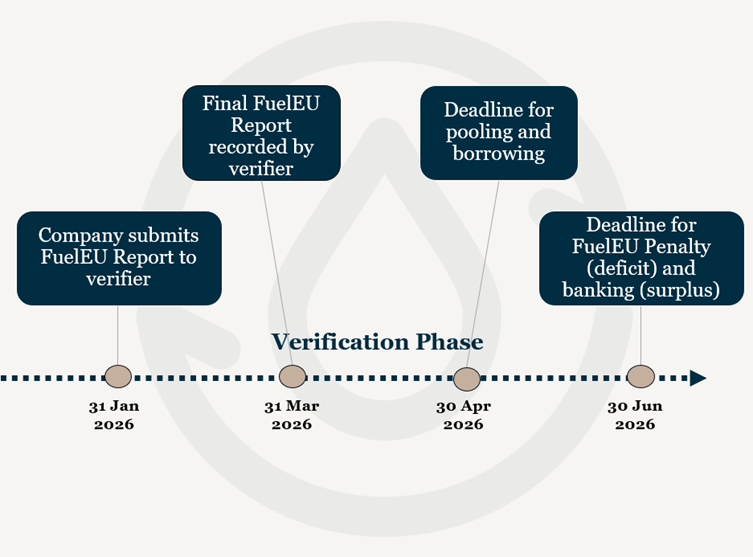
The company shall submit the FuelEU report to the verifier. This is the first major deadline and requires companies to have compiled all data on fuel and energy consumption for EU voyages conducted during 2025.
The verifier is then to verify the data and to calculate the compliance balance of the vessel, and any misstatements or non-conformities identified by the verifier are to be handled immediately by the company.
The verifier shall notify the company of the assessment of the FuelEU Report and the calculations of the GHG intensity of the energy used onboard. This will allow the company to determine a strategy for compliance, namely if it intends to use the flexibility mechanisms (pooling, etc.) or not.
By this date, companies will – with certainty – know their final compliance balance for 2025 – whether they have a compliance surplus (over-compliance) or compliance deficit (under-compliance).
The decisions relating to any borrowing of an advance compliance surplus or pooling need to be recorded in the FuelEU database.
This deadline is, if any, the true critical deadline under the FuelEU, in particular in respect of vessels with deficits. It is key to use the flexibility mechanisms – borrowing or pooling – no later than on this date as the company (the DoC holder) will otherwise be required to pay the FuelEU penalty.
It is key for stakeholders to understand the flexibilities offered by the pooling mechanism. In essence, it allows two or more ships to pool their compliance balances regardless of whether ships belong to the same or different companies. The total pool compliance balance must be positive or zero, but individual ships may exit the pool with a deficit provided the aggregate remains compliant. Ships with a compliance deficit before pooling cannot, however, have a worse deficit after pooling, and ships with surplus cannot end up with deficit. It is possible to arrange a pool among ships which are already compliant simply to reallocate compliance surpluses between vessels – which may be relevant for instance on an intergroup level.
Importantly, however, it is not possible to apply pooling and borrowing for the same reporting period for the same vessel. This may create issues when parties have agreed e.g. to allow time charterers to pool the vessel for a reporting period with the exclusion of off-hire periods which is left for the owners to handle. It is therefore important for owners and charterers to explicitly agree how to handle the compliance balance for off-hire periods to avoid that the owners end up, unnecessarily, paying the FuelEU penalty.
In the event of a negative Compliance Balance, the associated administering state shall calculate and communicate the value of the FuelEU penalty to the responsible company by 1 June.
The verifier (or administering state if any penalties are due and pay) has to issue a FuelEU document of compliance for the ship concerned (this DoC not to be confused with the ISM DoC). The penalty has to be paid by 30 June. If the company fails to pay any outstanding penalties, the vessel may ultimately be detained by the member states and subject to criminal sanctions put in place by the member states.
Under the FuelEU Regulation, shipping companies must be able to demonstrate that any renewable and low-carbon fuels used by ships adhere to sustainability and GHG savings criteria defined in the Regulation in order to obtain the GHG benefits associated with such fuels. We have previously provided an extensive background on the certification issues relating to FuelEU in our newsletter of 24 August 2024[5].
Importantly, the requirements on certification for such fuels under FuelEU are linked to the general certification schemes provided under the EU Renewable Energy Directive (“RED”). This entails that the fuels should be certified under a RED-recognised scheme (such as ISCC). Furthermore, the intention is for the fuels are also to be digitally recorded in the Union Database for Biofuels (“UDB”) which is, however, not currently fully operational. Until then, shipping companies will need to require sustainability documentation from fuel suppliers in addition to the BDN, primarily a Proof of Sustainability (PoS) declaring supplier, recipient, product details, and well-to-wake emission factor. Where Member State requirements prevent fuel suppliers from sharing PoS documents, they must provide equivalent evidence such as a Proof of Compliance (PoC), subject to acceptance by the verifier. Companies should ensure fuel suppliers provide appropriate certification and establish procedures for timely document exchange. Furthermore, once the UDB is fully operational, suppliers as well as owners should make sure to use the UDB as required.
From a contractual point of view, it may be a problem that the suppliers will often not be able to provide the required documentation, such as PoS and PoC, in connection with the delivery of the fuel (and the BDN) but only within 30 days from that date. Buyers of biofuel should thus consider contractual protections to avoid paying for biofuel which is not supplied with the relevant RED/FuelEU documentation. It may for instance be agreed that the biofuel premium is only payable on condition of receipt of this documentation.
Another, more fundamental problem, is that the UDB currently only recognises certification of fuels sourced from gaseous products which are traceable on the integrated European gas grid. This entails that such renewable fuels sourced from non-EU energy markets, such as North America, will not be able to enjoy the benefits under the FuelEU (and EU ETS). No short-term solution exists to the issue as the Commission is unlikely to approve such foreign products under RED unless the Commission is satisfied that the foreign gas grids can ensure sufficient levels of traceability, verifiability and avoid any double counting.
As noted above, the Commission’s implementing regulation providing detailed rules on the operation and functionality of the FuelEU Database remains outstanding. This creates uncertainty regarding database access and transfer procedures, particularly for vessel sales occurring before the compliance decisions for the prior reporting period have been executed. The regulation provides that the ‘company’ as of 31 December is responsible for compliance, whilst access to the FuelEU Database is currently removed once the partial report has been submitted, making it unclear how sellers can effectuate decisions for the prior year.
It may be critical for stakeholders dealing with ships which just have or will change DoC holder in the coming months (due to a sale and/or change of external technical management) to check for the update of the FuelEU Database and, to the extent possible, to collaborate to ensure that the appropriate entity has access to the FuelEU Database and that the actual, intended decisions on the Compliance Balance can be effectuated.
The parties negotiating contracts and clauses relating to FuelEU compliance have different commercial interests and regulatory hurdles to consider. A common issue is that the regulatory entity – the ‘company’ – is the DoC holder (often an external technical manager) whereas the commercial entity being responsible for the fuel procurement and commercial management is often a different entity, either the registered owner or a time charterer. Another typical issue pertains to the transfer of responsibilities from for instance a seller to a buyer which involves the need to share data and the pricing of the (often unknown) pooling cost. To no surprise, the contract clauses are still evolving in the marketplace and with many variations.
Below, we have outlined some of our observations on the main contracts from the prior year:
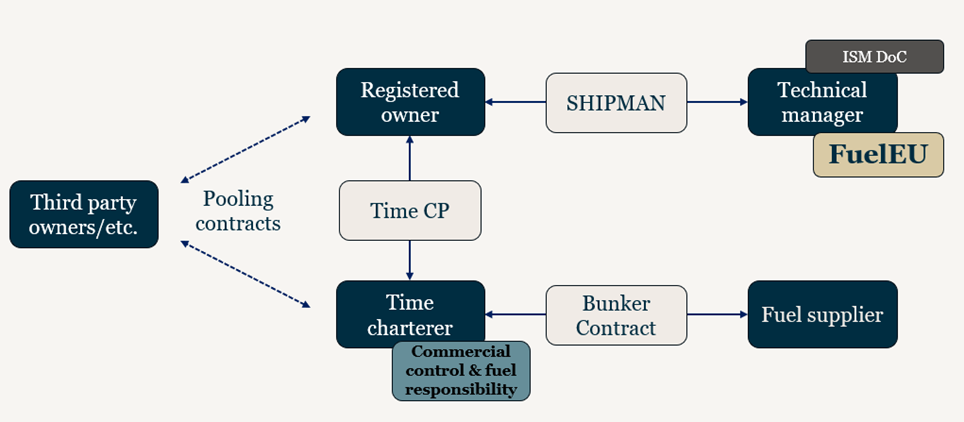
Time charter party clauses remain highly variable as stakeholders continue to familiarize themselves with the FuelEU framework. While many time charter clauses are based on BIMCO’s standard clause of 2024, long-term charters frequently incorporate extensive amendments reflecting the parties’ specific risk allocation preferences; in particular charterers and owners may often wish to avoid the monthly settlement of the compliance balance. A notable feature is the use of market indices and third-party assessments to determine compliance balance costs, as charterers have shown reluctance to accept pricing of deficits being tied to the FuelEU penalty.
Ship management terms are often based on BIMCO’s standard FuelEU shipman clause, though with considerable variation in implementation. A key area of divergence concerns security arrangements – as the need for the protection of manager’s responsibility vary depending on the owners. Negotiating positions vary extensively depending on the parties’ relative bargaining power, and owners frequently prove unwilling to grant managers the full scope of the powers contemplated under the BIMCO standard clause.
BIMCO introduced a new standard FuelEU clause for memoranda of agreement in late December 2025. This clause will likely achieve broad market adoption and may prove more readily acceptable to parties without extensive amendments, given the more straightforward nature of compliance allocation in the sale and purchase context compared to ongoing operational relationships under e.g. time charters.
Pooling arrangements show extensive variation in structure and terms, reflecting fundamental differences in their commercial nature. Contracts differ significantly depending on whether they are concluded on a one-off basis following verification of final compliance data, or negotiated well in advance – as forward pooling contracts – with no certainty as to actual compliance outcomes. Each type of pooling contract presents distinct risk profiles and pricing considerations for the parties involved. It thus seem unlikely that any standard form will be developed and adopted broadly in the industry in respect of pooling contracts.
The first verification period in 2026 will definitely be a learning experience for the industry. Companies should expect potential administrative challenges as the FuelEU Database and verification processes are implemented for the first time and due to the need for further guidance from the EU Commission.
Furthermore, certain technologies – such as onboard carbon capture – are not yet recognised under FuelEU and may not be so prior to, at least, the mandated review in 2027. Following another postponement at the end of 2025, it is also yet to be determined when Norway and Iceland will be included in the FuelEU scope [6]. Whether or not the great unknown – the IMO Net Zero Framework – will be passed, we are thus certain to see significant developments on both the regulatory and contractual front in the years to come.
At Gorrissen Federspiel, we have extensive experience advising on FuelEU Maritime compliance, including charter party clauses, management agreements, sale and purchase agreements, commercial pooling arrangements and FuelEU pooling contracts. We are a proud knowledge partner of the Maersk Mc-Kinney Møller Center for Zero Carbon Shipping, assisting the centre on legal and regulatory matters.
[1] For more information on the FuelEU Regulation please see our newsletter of 11 April 2024 (link).
[2] Guidance on the FuelEU Maritime Regulation, 28 October 2025. Other reports on for instance certification and calculation methods are available on DG Move website (link).
[3] Implementing Regulation (EU) 2025/1127 of 6 June 2025. Only East Port Said, Egypt, and Tanger, Morocco, have been designated as neighbouring container transshipment ports.
[4] For a status on implementing regulation see the website of DG Move (link).
[5] Newsletter of 24 August 2024 (link).
[6] Announcement by Norwegian Maritime Authority of 22 December 2025 (in Norwegian) (Link).