


The international regulatory space for maritime decarbonisation is constantly evolving with many changes to be expected in the coming years. This newsletter will cover the new UK ETS, the EU Commission’s recent proposal for the amendment of the EU ETS as well as other international developments on emission trading schemes in the shipping industry – and consider how these new measures and proposals may impact the owners, charterers and other stakeholders.
Most shipowners have in recent years become accustomed to the EU ETS and the obligation to surrender allowances each September for the prior year. The purpose of this newsletter is to provide an update of the more recent changes and the new proposal relating to the ETS Directive as well as the other developments around the world.
The regulations on emissions allowances start with the data. The EU Commission has therefore sought to update the EU’s regulation on monitoring, reporting and verification (“MRV”) to allow for future updates to the scope under the EU ETS Directive.
While the MRV previously only applied to general cargo vessels above 5,000 GT, as of 1 January 2025, such vessels in the range above 400 GT and up to 5,000 GT have been included within the scope of the MRV.[1] Consequently, the DoC holder under the ISM Code[2] will, for each such vessel under its responsibility, be subject to the reporting requirements in respect of all EU-related voyages. This development follows the recent expansion of the MRV regime, which, since January 2024, has required the MRV of greenhouse gas (“GHG”), comprising not only carbon dioxide (CO2) emissions, but also nitrous oxide (N2O) and methane (CH4) emissions from maritime transport.
Beginning in 2025, the MRV was extended to offshore vessels (also above 4oo GT). The Commission adopted a Delegated Regulation in October 2024[3] to clarify the rules for the monitoring of GHG emissions from offshore vessels under the MRV Regulation.
The exact types of “offshore vessels” have been listed in the above-mentioned ‘Delegated Regulation’. The term covers a long list of vessel types – such as anchor handlers, crew transfer vessels and drilling vessels, pipe and cable layers and dredgers. As cargo vessels are already covered, it ensures that most vessels – other than fishing boats and naval and other governmental vessels – are now covered by the MRV Regulation.
Based on the dataset to be collected under the MRV, larger offshore vessels – above 5,000 GT – will be included in the EU ETS with effect from 1 January 2027.[4] It will entail that owners and other stakeholders will need to consider the cost impact and amend the charter parties, dredging and installation contracts and other relevant project contracts[5].
The extension of the MRV and ETS to offshore vessels is based on the general concept of port calls. This has been criticised by stakeholders as many types of offshore vessels are typically not engaged in the traditional transportation of cargo and passengers but rather in various maritime services in or outside of ports. As of now, the Commission has not altered the regulations which therefore still use the concept of port calls for data purposes.
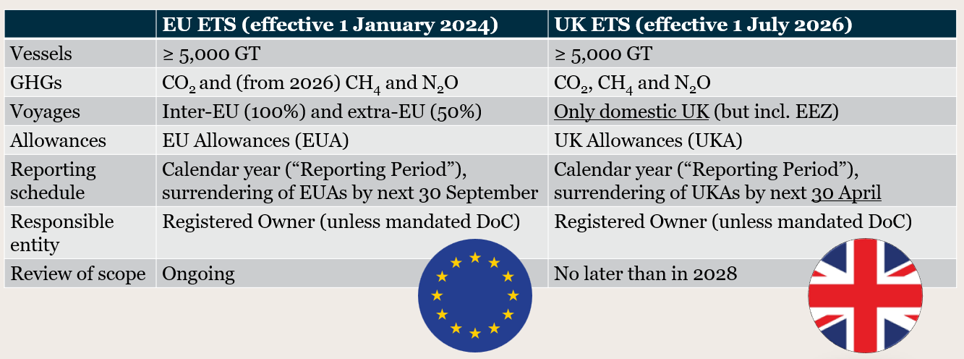
The UK is, also in respect of maritime decarbonisation, in a special position due to Brexit. On one hand, the UK requires shipowners (for vessels of at least 5,000 GT) to submit data under the ‘UK MRV’ for voyages involving the UK because the UK was part of the EU when the MRV was introduced[6]. While the UK has its own UK ETS in place for industries such as power generation and aviation – based on the EU ETS – the UK ETS did not previously extend to marine transportation because it was only implemented by the EU after Brexit. The UK has therefore now extended the UK ETS to shipping effective 1 July 2026.
In March 2025, the UK government launched its Maritime Decarbonisation Strategy which seeks to reduce well-to-wake GHG emissions.[7] The strategy aspires to align with the upper range of the IMO targets, aiming for a 30% reduction in GHG emissions by 2030 and an 80% reduction by 2040, ultimately striving for zero GHG emissions by 2050.[8]
Following consultations[9], the UK adopted the Greenhouse Gas Emissions Trading Scheme (Amendment) (Extension to Maritime Activities) Order 2026 which extended the UK ETS to shipping with effect from 1 July 2026.[10] The main points are set out below:
A formal consultation has been launched on the expansion of the UK ETS to international voyages (more akin to the EU ETS), with implementation proposed from 2028.[19] The EU Commission has also expressed good progress on negotiations with the UK government on the potential ‘linking’ of the UK ETS with the EU ETS.[20]
Several other countries around the world have also adopted or are considering introducing an ETS or other emission related levies for the shipping sectors. This section is not exhaustive but sets out some of these implemented or planned systems.
Among the other global ETS initiatives, under the Sovereign Carbon Initiative, Djibouti and Gabon have introduced a carbon contribution for aviation and maritime transport operators (referred to as “obligors” under the initiative[21]) and the creation of the Sovereign Carbon Registry, enabling obligors to record their emissions and to follow their efforts of compensation. The measures aim to reduce GHG emissions produced by maritime operators transiting and/or operating in Djibouti and Gabon.[22] Liberia was also reportedly considering putting up a carbon levy on shipping via the Sovereign Carbon Initiative but clarified earlier in February 2026 that it would await the IMO developments.
As another example, in July 2024, the Parliament of Türkiye approved statutory changes to allow for the taxing of vessels entering Turkish ports based on their GHG emissions.[23] We understand that further regulations still need to be passed to set out any wider framework for the ETS within shipping, and the shipping sector appears not to have been part of the secondary regulations concerning the ETS presented on 27 August 2026[24]. It therefore remains to be seen whether and when Türkiye will pass regulation to effectively address the risk of evasion in relation to the EU ETS for Turkish ports.[25]
On 17 July 2026, the Commission published its long-awaited proposal for comprehensive amendments to the current ETS Directive (the “ETS Proposal”)[26]. The ETS Proposal intends to provide some relief to European industries by, for instance, lowering the trajectory for the reduction of the cap of the total allowances included under the scheme.
The ETS Proposal keeps the main incentives for the industries to decarbonise and is intended to ensure that more funds are returned to the industries, e.g. by the establishment of the Industrial Decarbonisation Bank and further support for the EU Innovation Fund.
The Commission expects that the revised ETS Directive will be passed during 1st quarter of 2027, with the main amendments taking effect from 2028 or later.
The main amendments that are specific to shipping are set out below.
The EU ETS currently only applies to vessels of at least 5,000 GT, a feature which has attracted considerable criticism for the disruptive effects on competition. Owners of vessels below 5,000 GT have simply obtained an undue competitive advantage compared to owners with vessels just above who have had to surrender EUAs for their voyages.
Following extensive studies on the administrative burdens of expanding the MRV and the ETS[27], the ETS Proposal provides that the ETS is to be extended to vessels under 5,000 GT but above 400 GT within certain segments[28].
Oil tankers, chemical tankers, gas carriers and LNG carriers below 5,000 GT and above 400 GT will thus be added to the scope of both the MRV and the EU ETS pursuant to the ETS Proposal, commencing in 2029[29]. Similarly, general cargo ships and offshore ships of this size which are already subject to MRV will be covered by the EU ETS[30]. By contrast, RoPax ships and passenger ships in the same size range are proposed to be included in the MRV framework from 2029 but not in the EU ETS.[31] The Commission shall though no later than in 2031 consider the potential inclusion of such vessels into the EU ETS.[32]
Since the EU ETS was introduced in shipping in 2024, the risk of evasive behaviour has been well known as the ETS liability only applies in respect of 50% of the emissions on extra EU voyages (meaning voyages to/from an EU port). It creates, at least in theory, an incentive to call ports just outside of the EU before proceeding from or after leaving the relevant port in the EU as this would shorten the voyage fully within the ETS framework. The implementation regulation on transhipment ports (applicable to container shipping) thus designated the certain non-EU ports as ‘transhipment ports’ which cannot be deemed as ports under the EU ETS, preventing the use of these ports for evasive purposes[33].
Based on the findings of the EU Commission on shipment patterns, the evasive actions have not been very significant[34]. The EU Commission therefore found that no fundamental changes were needed. The Commission does though suggest lowering the threshold for identifying a neighbouring container transhipment port from 65% to 50%, and ports with suitable transhipment infrastructure located within 150 nautical miles of a member state port are excluded from the definition of “port of call”[35].
Furthermore, offshore worksites where vessels perform or support offshore operations are included within the definition of “port of call”.[36] Shipowners and operators on affected trade routes should review the potential impact on their ETS surrender obligations.
Clearly, the implementation of an ETS for international voyages in the UK as well as the plans in Turkey as further described below could mitigate such risks. As of now, as noted below, the extent of these measures will likely not fully eliminate the risks of evasion due to the limited scope, initially, of at least the UK ETS for shipping.
The “ETS as a Service” is introduced to enable non-EU states to participate in EU carbon pricing for maritime voyages in respect of emissions not already subject to surrender obligations under EU ETS. The proposal mentions that this would facilitate the implementation of the ETS linking agreement being prepared between the EU and UK.[37]
The ETS Proposal introduces several other changes applicable to shipping:
The ETS Proposal also introduces measures to simplify compliance under both ETS/MRV Maritime and the FuelEU Maritime systems, including by ensuring that only one report is to be filed for MRV, ETS and FuelEU purposes. While the details are yet to be set out, the Commission estimates this will reduce MRV compliance costs by 10-20%.[42]
Further to the planned amendments, the ETS Proposal acknowledges that further changes should be considered depending on the adoption of the IMO measures (described below). EU legislative proposal following the adoption of a global IMO market-based measure must include a deduction mechanism to prevent double payment.[43]
As is well known, the IMO is working on a global decarbonisation measure known as the IMO Net Zero Framework (NZF)[44]. The Marine Environment Protection Committee (MEPC) approved the principles for the NZF at its 83rd session in April 2025, only for the vote to be unexpectedly postponed in October 2025 with a year. The industry is thus keenly awaiting the vote on the potential adoption of the measure late this year.
Noteworthy, the NZF is not structured as a global carbon levy as the EU ETS or other levies such as the African Sovereign Carbon Initiative. Rather, the NZF would establish a global fuel standard that requires vessels to reduce their annual GHG fuel intensity on a well-to-wake basis, more akin to the FuelEU. The Commission has therefore also announced that it will review FuelEU, should the NZF be passed, and potentially align the measures.
The developments show that the ETS schemes are here to stay and that they will impact more and more geographies and more types of vessels. Irrespective of whether we will see new international schemes in the IMO, such as NZP, these are unlikely to fully replace the ETS as a driver for decarbonisation measures on a regional or national basis. The ETS Directive will definitely be amended – it is just yet to be seen whether the Commission’s ETS Proposal will be passed, and which amendments thereto may be incorporated.
Consequently, owners, charterers, managers and other stakeholders should consider their long-term arrangements and, to the degree possible, make the terms applicable not only to the EU ETS but to emission trading schemes and other decarbonisation schemes. Fortunately, BIMCO has taken this exact approach in its ETS clauses which are a useful basis for negotiations. In fact, the main ETS clauses for time charters, for instance, work for the UK ETS, meaning no further amendments will be needed on such basis.
Gorrissen Federspiel is a knowledge partner of the Mærsk Mc-Kinney Møller Center for Zero Carbon Shipping and provides advice to owners, charterers, fuel suppliers and other industry stakeholders on the implementation of IMO measures, EU regulations, voluntary carbon reduction schemes and other decarbonisation initiatives in the shipping, offshore and energy sectors.
[1] Regulation (EU) 2023/957 of 10 May 2023 amending Regulation (EU) 2015/757 (the “MRV Regulation”).
[2] This may be either the registered owner or a bareboat charterer or technical manager who has assumed the responsibilities under the ISM Code.
[3] Commission Delegated Regulation (EU) 2024/3214 of 16 October 2024.
[4] Directive 2003/87/EC of 13 October 2003 establishing a system for greenhouse gas emission allowance, as amended by Directive (EU) 2023/959 of 10 May 2023 (“ETS Directive”).
[5] For the potential changes set out in the Commission’s proposal of July 2026, see further below.
[6] The Merchant Shipping (Monitoring, Reporting and Verification of Carbon Dioxide Emissions) (Amendment) (EU Exit) Regulations 2018.
[7] This essentially encompasses GHG emissions from the production and distribution of the fuels and other energy sources used by maritime vessels (“well-to-tank”); and GHG emissions from operating maritime vessels (“tank-to-wake”).
[8] Maritime Decarbonisation Strategy, UK Department of Transport 2025, pp. 32 et seq.
[9] UK Emissions Trading Scheme: Main Authority response to the Scope Expansion: Maritime consultation, November 2025 (“Main Authority Response”).
[10] The Greenhouse Gas Emissions Trading Scheme Order 2020 no. 1265, schedule 2a Maritime, article 34ZA, of 1 July 2026 (“UK ETS Scheme”).
[11] UK Environment Agency Guidance: “UK Emissions Trading Scheme for maritime: how to comply”, 22 June 2026, example 2 (“UK Guidance”).
[12] UK ETS Scheme paragraph 7(3).
[13] UK ETS Scheme paragraph 5(1).
[14] UK ETS Scheme paragraph 5(1) and Main Authority Response, pp. 12-13.
[15] UK ETS Scheme paragraph 15(2).
[16] See our newsletter on certification of 22 August 2024 for further info (link): FuelEU | Certification and Fuel Supply Agreements – Gorrissen Federspiel.
[17] UK ETS Scheme paragraph 3. Note that, unlike the EU ETS, no DoC required under the UK ETS. The DoC requirement was removed in the Main Authority Response.
[18] UK ETS Scheme paragraph 15(1)(a).
[19] Main Authority Response, p. 26.
[20] EU Commission statement of 17 December 2025 (Statement/25/3103).
[21] The current framework of the initiative does not clearly identify the primary stakeholders within the shipping industry who are subject to the obligations for the “obligors”.
[22] Decree no. 2023-074/PRE, of 13 March 2023, establishing a Carbon Contribution and Compensation Mechanism, Djibouti Republic; and Law no. 0054/PR/MECCHF, of 16 January 2025, on the Institution of Greenhouse Gas Emissions Control and Compensation Mechanism for Air and Maritime Transport Actors Transiting or Operating in the Gabonese Republic.
[23] www.marinetraffic.com: New Emissions Trading Scheme by Turkey to prevent dodging of emissions tax (last time accessed: 1 September 2026).
[24] Official Gazette Regulation 33353 of 27 August 2026: https://www.resmigazete.gov.tr/eskiler/2026/08/20260827-7.htm
[25] EU ETS Directive Report, p. 12.
[26] Proposal for a Directive of the European Parliament and of the Council amending Directive 2003/87/EC and Decision (EU) 2015/1814 as regards driving competitiveness and cost-effective decarbonisation, COM(2026) 616 final, 17 July 2026 (“ETS Proposal”).
[27] See for instance the MRV Regulation Report of March 2025 (link). Report from the Commission Review of Regulation (EU) 2015/757.
[28] It is not unprecedented in that some Member States, including Austria, the Netherlands and Sweden, have already decided to include some smaller vessels within the scope of the new separate ETS framework, the ETS2. Ibidem, p. 16. See e.g. Delegated Decision (EU) 2025/318 of 27 November 2024 on the Sweden’s inclusion of sectors for the EU ETS.
[29] Art. 2(1d)(a)-(d) of the MRV Regulation (proposed).
[30] Art. 2(1a) of the MRV Regulation (proposed).
[31] Art. 2(1d)(e)-(f) of the MRV Regulation (proposed).
[32] ETS Proposal, Art. 3gg(5).
[33] Currently only two ports are listed: East Port Said, Egypt and Tanger Med, Morocco (Commission Implementing Regulation (EU) 2023/2297 of 26 October 2023 annex).
[34] Report from the Commission Monitoring of the implementation of Directive 2003/87/EC in relation to maritime transport of 18 March 2026 (the “EU ETS Directive Report”). As per the report, evasive behaviours can be defined in a broad sense as operational adjustments that circumvent ETS rules and reduce the amount of GHG emissions to be reported under the ETS scope, without actually implementing GHG mitigation measures such as improvements in energy-efficiency or use of alternative fuels/cleaner vessels.
[35] ETS Proposal, Rec. (22).
[36] ETS Proposal, Rec. (22) and (23), Art. 3ga(2) and Art. 3, point (z).
[37] The ETS Proposal, Rec. (26) and Art. 25b (proposed).
[38] The ETS Proposal Art. 12 (proposed).
[39] Read more about SMAP in our upcoming newsletter.
[40] The ETS Proposal, Rec. (20) and Art. 3gaa (proposed).
[41] Art. 14(1a) of the ETS Directive (proposed).
[42] ETS Proposal, explanatory memorandum, pp. 17-19; amended Art. 2 of Regulation (EU) 2015/757 and Regulation (EU) 2023/1805.
[43] ETS Proposal, Rec. (18) and Art. 3gg (proposed).
[44] For further information on the NZF, we refer to our newsletter of 16 April 2025 (link).