



This is a significant issue as nearly 800 buildings are DGNB-certified, and approximately 55 per cent of all major new constructions are certified under the DGNB scheme. A clear solution is therefore urgently needed.
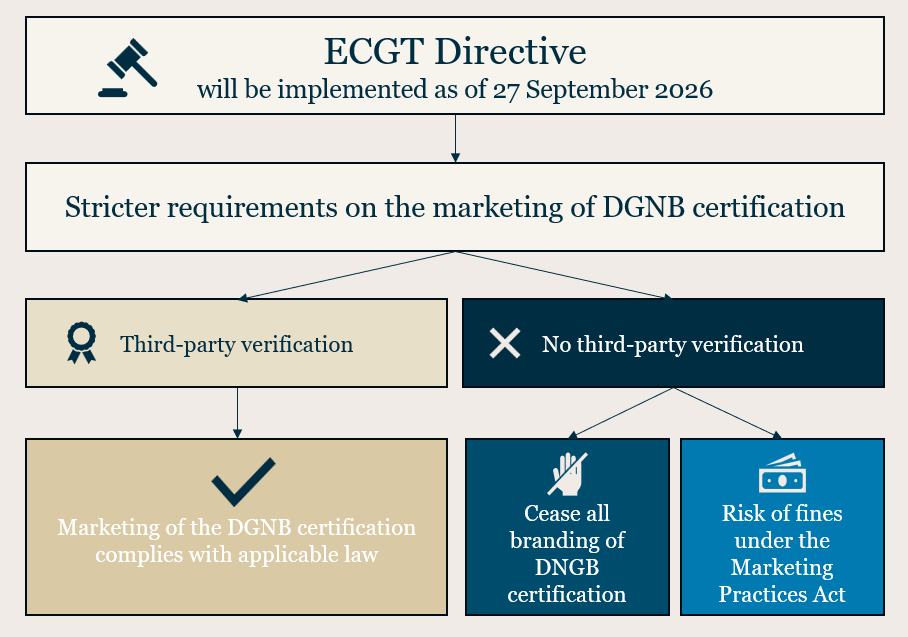
The forthcoming implementation of the ECGT Directive into Danish law requires that sustainability certification must either be established by public authorities or governed by a certification scheme that ensures objective supervision. This supervision must be carried out by an independent third party. Specifically, the requirement for third-party independence means that the certifying body must be independent of both the owner of the certification scheme and the company seeking certification.
The requirement for supervision by an independent third party poses a challenge to the current Danish DGNB scheme. Currently, the Green Building
 Council Denmark administers the DGNB scheme, while also being responsible for the certification process through its wholly-owned subsidiary, DGNB.dk ApS.
This supervision model does not comply with the forthcoming requirements for third-party independence. From 27 September onwards, property owners who market their properties with DGNB certificates risk incurring fines for violation of the new rules.
Such violations and fines can only be avoided if independent third-party verification is introduced and carried out by 27 September 2026 when the new rules come into effect. Otherwise, property owners must cease branding their properties with previously obtained DGNB certificates until they have been verified by an independent third party.
Sustainability certifications hold significant value, not only from an environmental perspective, but also in terms of potential economic benefits for property owners.
According to the Report on the Value of Certifications in the Construction and Real Estate Sector, issued by Green Building Council Denmark on 28 January 2026, sustainability certifications hold significant economic value.
The report points out that:
The report also highlights certification as a focus and tool that is in increasing demand amongst investors.
Sustainability schemes impose stricter requirements than legislation and necessitate the documentation of environmental and climate impact. According to the report, this increased transparency reduces uncertainty regarding future risk profiles among investors and property owners. Some investors explicitly require certification in connection with new property developments and real estate acquisitions. This reflects the fact that green certifications are increasingly being integrated into investment strategies and are an important consideration for the long-term preservation of asset value, particularly in relation to potential future sales.
Since its issuance, the report has been subject to criticism by market players. The main issues raised are a lack of transparency and an overwhelming desire to present the DGNB scheme in a favourable light.
In particular, the following points of criticism can be highlighted:
Despite the disputed value of the report issued by the Green Building Council, the DGNB scheme is widely used and well established. This is evidenced by the fact that 55 per cent of all major new constructions are – and will be – DGNB certified.
As the current DGNB certification and supervision model does not appear to meet the third-party independence criterion that is to be implemented into Danish law by late September, property owners who market their properties as DGNB-certified after this time, risk incurring fines for violation of the new rules.
Regardless of their contested value, sustainability certifications remain a useful tool for property owners and an important metric for investors, so finding a workable solution is essential. Gorrissen Federspiel is closely monitoring the situation and expects the Danish Green Building Council to provide clarification ahead of the 27 September deadline.
Gorrissen Federspiel’s Real Estate group brings extensive experience across the full spectrum of real estate matters. We advise clients on all aspects of real estate transactions and operations, including the attainment and marketing of sustainability certifications, as well as on the liability risks associated with regulatory non-compliance.